Tuesday, December 17, 2013
A Belated Happy Hanukkah from 1941
The newsletters, newspapers and serials in the Religion in North Carolina Digital Collection provide windows into how some North Carolinians viewed the events of the past.
As an example, consider December 1941. The surprise attack on Pearl Harbor and the resultant American entry into World War II overshadowed much of American life in that month.
Unsurprisingly, The American Jewish Times was no exception. The January 1942 issue contained articles about Jewish soldiers in the army, patriotic poetry and advertisements for war bonds.
But December 1941 also included the festival of Hanukkah, which the same January issue spotlighted with several articles on topics such as "The Significance of Chanukah" and "The Menorah, Symbol of a People". Nor were these topics unrelated, with a political cartoon symbolically equating the candles of Hanukkah with American freedoms.
In addition to these features, the January 1942 issue includes advertisements for local and national businesses, as well as articles on other topics of interest (see the index on this page).
To browse this issue, click on the link above or go to the 1940-42 volume of The American Jewish Times Outlook. To browse The American Jewish Times Outlook or other religious newspapers from North Carolina, visit the Newsletters, Newspapers and Serial Publications section of the NC Religion project at the Internet Archive.

Tuesday, November 26, 2013
Duke Publishes its 2,000th Volume

Originally from Pensacola, Florida, Moses grew up in Mobile, Alabama. He was brought there when he and his mother were freed from slavery by his white father, and was raised as an Episcopalian. He distinguished himself in his studies, and was one of the few African American officers in the Union Navy during the Civil War. Meanwhile, Victoria (also born in Pensacola, but to Latino and African American parents) knew Moses while growing up in Mobile. She survived the Civil War, and an attempt to sell her into slavery, by fleeing first to Texas and then alone on horseback into Mexico. When she returned to Mobile at the war's conclusion, she found Moses, who was involved in publishing and post-war administration in both Louisiana and Alabama. They married, and Cleretta was born around 1887. Moses was devoted to the African Methodist Episcopal (A.M.E.) Zion Church , and had been ordained therein as a minister at some point during his life. According to Mrs. Avery, Cleretta was converted at the tender age of 18 months. Intelligent and outspoken, at the age of 3 she declared her intention to follow in her father's footsteps and preach, and did give her first sermon in Raleigh several years later at the age of 6. Her mother writes:
It was certainly marvelous to behold the command of language, knowledge of the Bible and elocutionary powers exhibited by her in this first sermon, of one half hour long, delivered to a large congregation. That sermon made her famous. Invitations to preach from churches and from white and colored people in the adjoining cities and towns poured in upon this tiny little preacher. (p. 7-8)Cleretta Nora Avery and her mother went on an evangelical tour, continuing even after Moses' death in Aberdeen, N.C. in 1895. Cleretta preached in North and South Carolina at first, but expanded her range to include Virginia, New York, New Jersey, and Massachusetts, among other states. This pamphlet includes letters of commendation, praise, and admiration written to her by various preachers, including Rev. Dr. J.S. Caldwell of New York and Pastor J.H. Welch of Charleston. Despite this fame and ability to preach, Cleretta seems to have been a normal child in many other aspects, which is reflected in a charming newspaper interview where she discusses her dolls at length with a reporter.
Read this short but informative pamphlet on her early life in our collection on the Internet Archive. Readers should note that while this pamphlet is written by Mrs. Avery, it does include language used to describe persons of color, which while common in the late 19th century, is considered offensive today. This short biography is a valuable and fascinating work as it not only examines the rise and popularity of an educated, young woman of color at a time when it was uncommon for women of color to receive education (the first African American woman to receive a BA, North Carolinian Mary Jane Patterson, graduated from Oberlin College in 1862, a mere 30 years earlier), but it was written and published by another educated woman of color. Its language and the image it grants us of non-white, female life in a variety of southern states before, during, and following the Civil War gives us another piece we can add to the puzzle of what the lives of women of color were like at a time of racial, social, and economic upheaval in our country.

Sources:
Avery, V.G. The Life of Cleretta Nora Avery, the Wonderful Colored Girl Preacher. Carthage, N.C.: Record Job Print, 1897.
Bailey, Richard. Neither Carpetbaggers nor Scalawags: Black Officeholders during the Reconstruction of Alabama, 1867-1878. Montgomery, AL: NewSouth Books, 2010.
Friday, November 15, 2013
The family unit

If you are interested in the topics alluded to above, flip through one of the eleven volumes. There's a treasure trove of material there. But today I'd like to spotlight another, more localized subject within the material: the family.


In preparing the serial for digitization, I noticed the frequency of articles related to the family. Witness stresses the importance of nurturing the family and provides conversational pieces filled with advice on strengthening the unity of families and marriages.

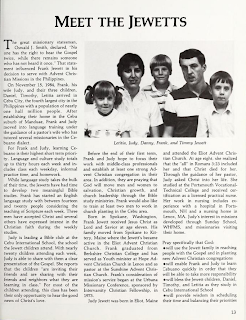


Additionally, other articles discuss the perceived challenges of cultivating a Christian family. The serial recommends for devoted practice of prayer and bible study along with constant communication and affection. Spending time together and embracing traditions are also stressed. Witness contemplates family life, morality and modern day temptations. Topics of concern run the gamut from drugs and pornography to Christmas holiday advertising.


Keep on scrolling...!


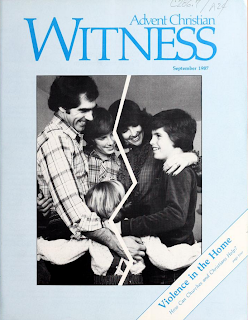
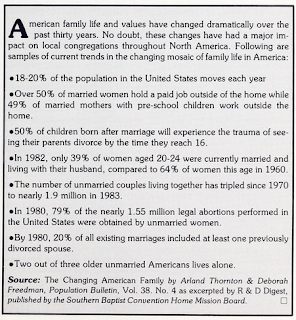
Users might find it interesting to consider conceptions and portrayals of family within the serial as well as the anxieties and advice given. Witness appreciates traditional models and comments on the changing shape of the American family. The publication reveres the bonds between married couples and families, and is dispirited by the increase in divorces, single-parent households and other trends in American life as outlined in the snippet below:
Friday, September 27, 2013
"Brunswick Stew p. 28"
Marginalia can tell us many things about the previous owners of a volume. In some cases, such as this note in the cookbook A Collection of Favorite Recipes, they can even tell us about the owners' favorite foods.

This note was handwritten on the cover, providing a quick reminder for where to find the Brunswick Stew recipe. Turning to page 28, we find that:
Mrs. H. H. Moore's Brunswick Stew recipe (not to be confused with Mrs. L. D. Moore's Brunswick Stew recipe right below it) is marked with an asterisk, which may correspond to the note on the front page.

A Collection of Favorite Recipes was compiled by the Women's Society of Christian Service at Hayes Barton Methodist Church in Raleigh. Created to raise funds for equipping a new kitchen, the cookbook contains recipes submitted by the parishioners. Feel free to flip through this item and look for recipes such as "Coffee Punch," "Old Virginia Spoon Bread," "Frankfurter Casserole," "Chicken Wiggle" or "Spanish Eggplant," as well as a wide variety of interesting local ads. Or head on over to the NC Religion collection on the Internet Archive, and check out our other cookbooks and items related to religious life and culture in North Carolina.
Monday, August 19, 2013
NC Religion goes to NOLA!
Just a few friendly acronyms for your Monday morning...


If you haven't already, check out the Internet Archive collection, our Facebook page and our Google+ page. There is primary material for those conducting research and neat information for those interested in casual browsing. Should you need a little inspiration, here are a couple of my favorite items! As always, we'd love to hear from you, be it in the form of comments, questions or suggestions by way of social media or e-mail.
Wednesday, June 26, 2013
NC Religion at The American Theological Library Association

The Duke Divinity School Library Staff attended the American Theological Library Association Annual Conference in The Queen City of Charlotte, North Carolina last week. Project Coordinator, Shanee Murrain presented a poster "The Religion in North Carolina Digital Collection: Content, Audience, and Presentation. The presentation featured background about the project planning grant, scope and audience, organizing content and workflow, copyright analysis, incidences of impact, digital output and Black Church identity politics as reflected in meeting minutes and church histories. Everyone wanted to know about the grant! Fellow librarians shared their interest and excitement about the digital collection. A few even asked Shanee to consult on their archival programs.
 |
| They are all so engaged! |

Monday, June 17, 2013
NC Religion Project Stats
This first year of digitizing materials is winding to a close. So here are a few statistics from the project.
As of June 13, 2013, there are 2,180 items online at the Religion in North Carolina Internet Archive Collection.
As of June 2, 2013, the download stats by month:
866 downloads in October 2012
1,319 downloads in November 2012
2,867 downloads in December 2012
6,065 downloads in January 2013
4,799 downloads in February 2013
9,902 downloads in March 2013
7,705 downloads in April 2013
10,822 downloads in May 2013
As of June 13, 2013, Duke has 305,933 pages online and UNC-Chapel Hill has 146,235 pages online and 287 foldouts online.
We are excited to continue scanning and sharing these materials! And we are glad to see that people are using the digitized items. If you are interested in the collection, but haven't yet seen it for yourself, navigate over to our page on Internet Archive.
Subscribe to:
Posts (Atom)